
Size matters.
So does motion.
Understand how grain sizes and vibration influence the structure of a granular bed.
Size classification prepares a feed for downstream processing. My vibration research investigates size segregation in Apollo regolith and simulants: a mechanism that can inform classification, rather than a demonstration of a complete classifier.
Look inside
a shaken bed.
Size classification conditions a feed for the next process. Vibration offers a way to explore that without a process fluid.
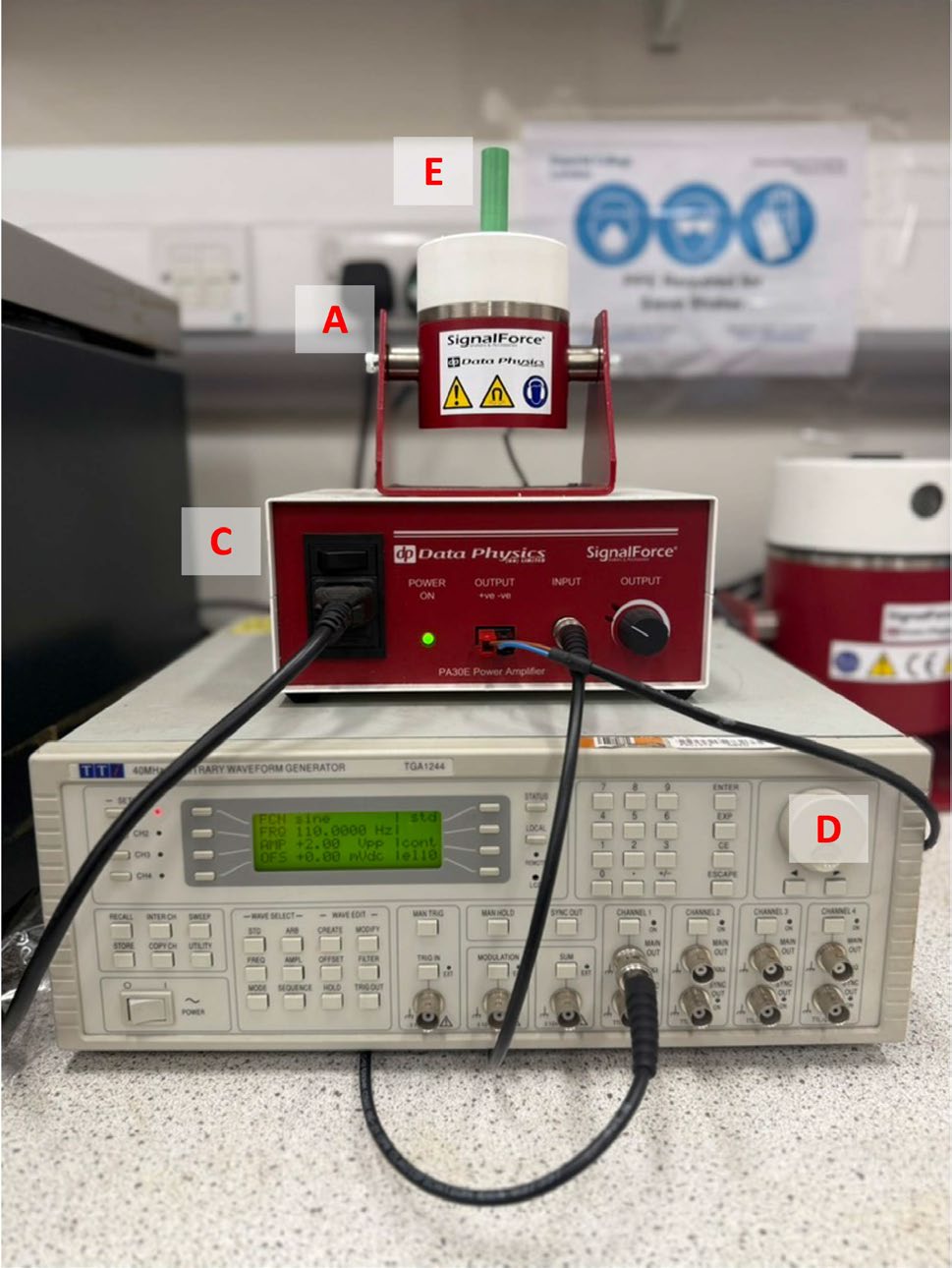
In our 2025 study, we compared Apollo 15 sample 15601 with JSC-1, LMS-1 and TUBS-M simulants using sealed-vial vibration and micro-CT. All tests were conducted under Earth gravity.
What we found
The Apollo sample formed a three-layer structure. Simulants responded differently: separating readily did not necessarily make a simulant representative. Particle-size distribution helped explain the different behaviours.
These are small-sample, terrestrial experiments. Their value is in understanding material response and evaluating simulants; they do not establish lunar operating performance.
Read the open-access study ↗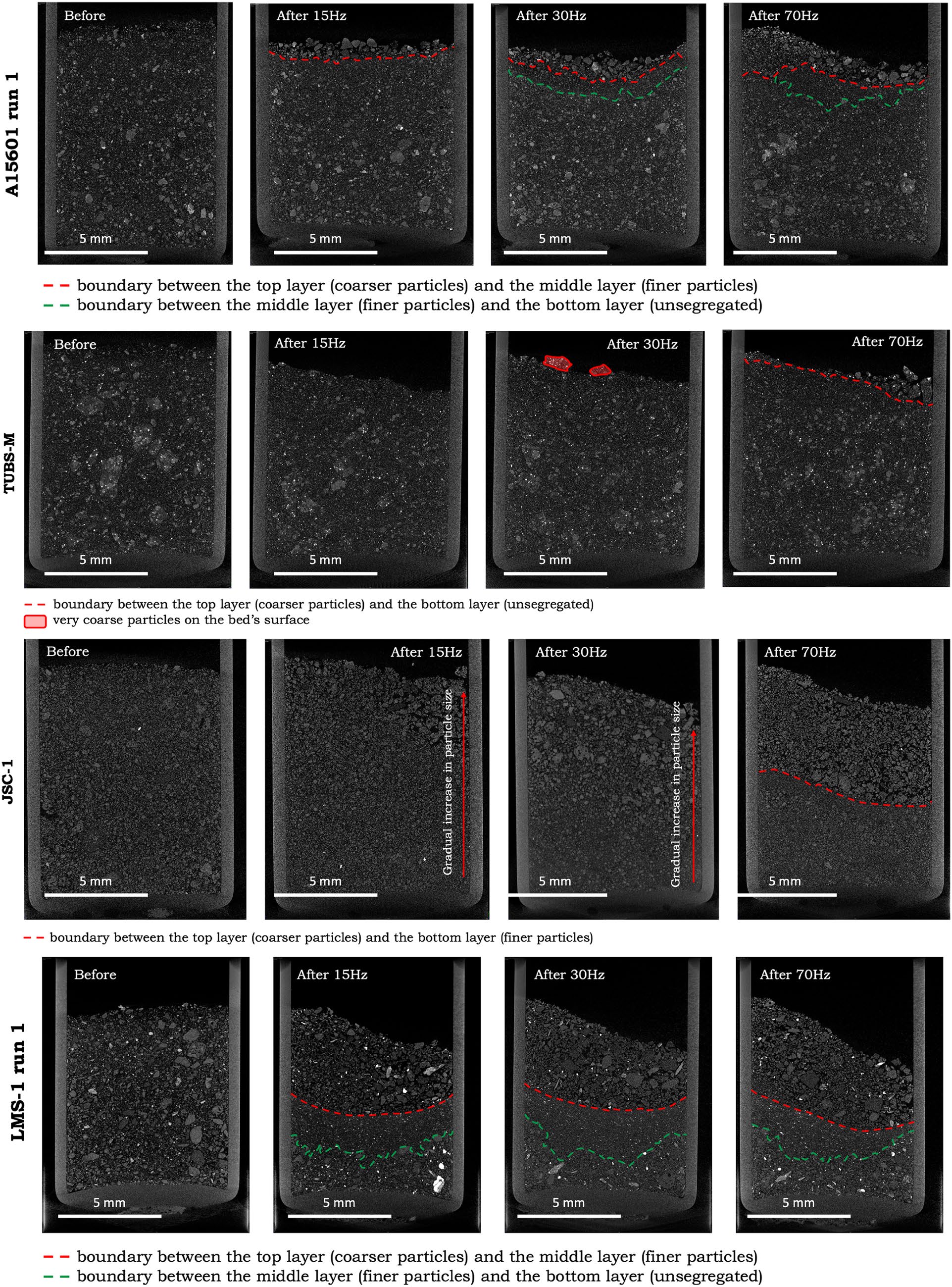
Small grains find gaps.
Large grains find the top.
Shaking can open spaces in a granular bed. Smaller grains can settle into gaps beneath larger grains, leaving the larger grains higher in the bed over successive cycles. Explore this one mechanism behind vibration-induced size segregation. Adjust the imposed frequency and peak amplitude, with slowed playback to keep the motion easy to follow.
Full stroke: 0.70 mm. Playback: 1/30 real time.
Watch fine grains fill the space beneath the larger grains as the illustration progresses.
The mechanism shownFine grains settle through openings in the bed. Repeated rearrangement can move larger particles upwards relative to their neighbours.
The research questionHow do particle-size distributions, material properties, container geometry and vibration conditions change the behaviour of real regolith and simulants?
How to read this appletFrequency and amplitude control the imposed container motion. Larger-grain paths remain guided, so changes in segregation rate are not experimental predictions. Peak amplitude is one-sided displacement; full stroke is twice that value. Displacement is enlarged for visibility and the drawing is not to scale. This is not a validated particle simulation or a prediction of lunar-gravity performance.