Characterise & test
Connect material measurements with a focused experimental programme.
 Dr Joshua RaseraMineral Processing & Resource Systems
Use differences in particle behaviour to enrich a mineral fraction.
My work connects material characterisation, tribocharger design and separator experiments with the choices needed for practical dry beneficiation.
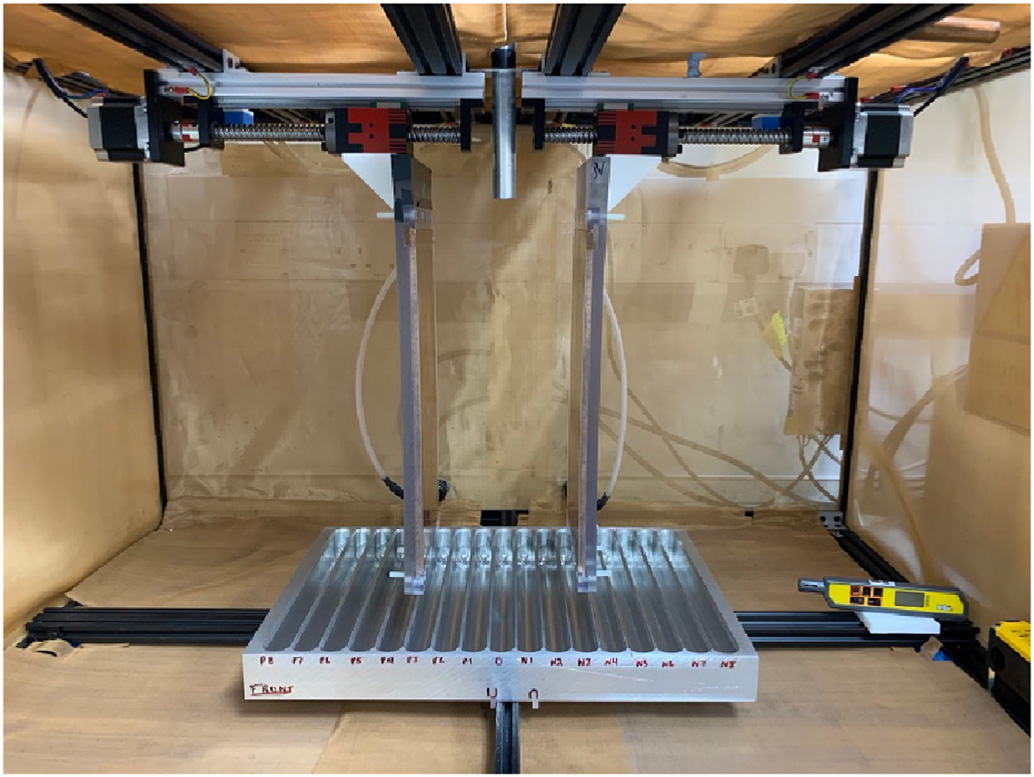
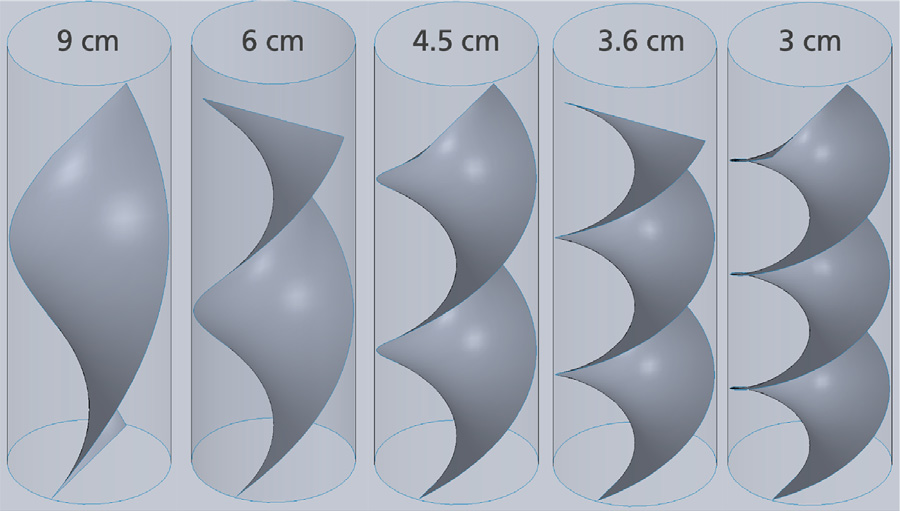
The path a particle takes through a tribocharger changes the contacts it experiences. Those contacts influence the charge it acquires.
My PhD investigated tribocharging through modelling and experiments. In discrete element modelling, I examined particle contacts to inform tribocharger design, then evaluated an optimised design in a free-fall electrostatic separator.
Under terrestrial test conditions, pure silica and ilmenite acquired negative and positive charge respectively. The tribocharger changed their motion through the electric field. In JSC-1 simulant, increased density in some collectors indicated enrichment of denser constituents.
The useful result is the connection between charger design, particle charging and measurable separation behaviour, with performance evaluated for pure minerals, binary mixtures and a more complex simulant.
Trace the connection between a tribocharger and a free-fall separator. Increase contact exposure to build charge, then change the electric field to see how that charge affects deflection. This conceptual applet uses silica-like and ilmenite-like particle classes.
More contact exposure increases charge towards a limit. Deflection depends on both charge and field strength.
What this explainsContacts influence charge acquisition. The field acts on charged particles, so changing charging conditions can change where material reports to a collector.
What my research investigatesHow contact history and tribocharger design influence charging, and how simulations can be tested against separator experiments.
Where the simplification stopsCharging follows an illustrative saturation curve, q* = 1 − exp(−4c), where c is contact exposure from 0 to 1. The coefficient, charge magnitudes and motion are not fitted to experimental data. Real feeds have distributions of charge, size and contact histories.
The paper compares collector distributions with and without the tribocharger. These photographs show the pure silica and pure ilmenite tests, rather than an applet output.
The charging and free-fall sequence above explains the idea. The published experiment establishes what happened in the tested apparatus and conditions.
Read the experimental paper ↗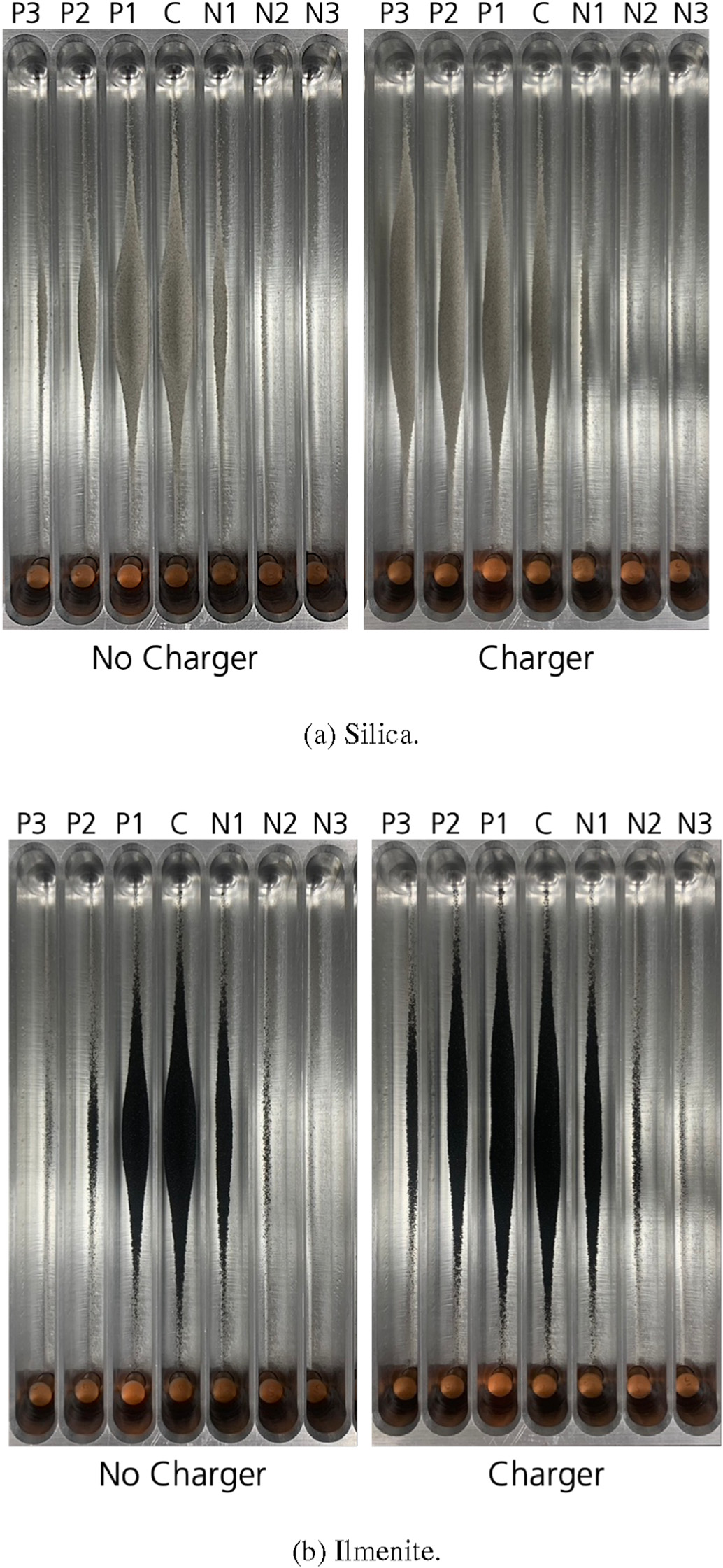
A substantial strand of my work concerns terrestrial dry mineral processing: connecting material properties to separation performance and practical process choices.
I work across characterisation, experimental investigation, performance analysis and flowsheet development. The questions extend beyond whether a separator works: what feed does it suit, how sensitive is it to conditions, and how does it fit into the whole process?
Particle size, mineral associations, texture and physical properties inform which separation mechanisms are plausible. I connect characterisation evidence with the design and interpretation of processing tests.
My experience spans evaluating dry separation options, including magnetic, electrostatic and density-based methods, and understanding their role alongside size classification and feed preparation.
Moisture and environmental conditions matter to dry processing. I investigate how material conditioning and changing feed properties influence behaviour, so that a technology is assessed in the conditions it needs to operate.
Connect material measurements with a focused experimental programme.
Use mass balances, partition behaviour and grade-recovery relationships to examine what a process is doing.
Compare classification, separation, recirculation and blending scenarios as connected process choices.
Bring recovery, product quality, resource needs and economic assumptions into the same discussion.
The aim is to make better use of mineral resources while reducing reliance on water and understanding the wider consequences of a processing choice.
Discuss a dry-processing challenge ↗Related lunar work examines sustainable pre-filtration, electrostatic and cyclonic dust control, and dust hazards in habitats. Managing the fine fraction connects processing, material handling and the systems people must operate.